






 |
|
|||||||||||||||
 |
||||||||||||||||











 |
|||
 |
Athens Odeon of Herodes Atticus (Herodeion) – History, Architecture & Significance 
Located on the southwest slope of the Acropolis, the Odeon of Herodes Atticus (Herodeion) is a stone built Roman theatre completed in 161 CE. Commissioned by the wealthy Athenian orator Herodes Atticus in memory of his wife Aspasia Annia Regilla, following Regilla’s death in 160 CE. Conceived as a memorial monument it was a gift to Athens, and with a capacity of around 5,000 spectators served as a venue for musical performances, lectures, and civic events. The building was the third major Odeon in Athens, following earlier structures by Pericles and Agrippa. Its construction may have been partly inspired by the collapse of Agrippa’s roof, prompting Herodes to create a more durable and impressive replacement. The building was to remain in use until the Herulian sacked Athens in 267 CE. This was a major destructive raid on Athens carried out by the Heruli, a Germanic seafaring group who penetrated deep into the Aegean during the third century. After breaching the city’s defences, the raiders entered Athens and inflicted extensive damage, burning public buildings and destroying monuments. Among the structures lost was the Odeon of Herodes Atticus, whose celebrated cedar‑wood roof was consumed by fire. The sack precipitated a significant urban contraction, leading to the hurried construction of the Post‑Herulian Wall around a much smaller city core, yet Athens recovered relatively quickly, demonstrating both its resilience and its continued regional importance despite the profound disruption of its monuments. Its ruins were incorporated into late Roman and medieval defensive walls. Systematic archaeological excavations began in 1849, uncovering inscriptions, seating, artefacts, and structural remains. The Odeon was designed as a steeply sloped, semi circular theatre in the Acropolis slope. This is known as the cavea, which is the seating bowl carved directly into the natural bedrock of the Acropolis’ southwest slope, it forms the auditorium in which spectators sat. Archaeological descriptions note that the cavea was constructed in stone and marble, arranged in sharply rising tiers to create a compact, acoustically efficient interior suited to musical and rhetorical performance rather than large-scale drama. It followed the typical Roman Odeon form, with seating divided into two main sections by a horizontal walkway (diazoma). Its steep gradient ensured clear sightlines and strong sound projection within the enclosed roofed structure. The cavea’s integration into the hillside provided structural stability and allowed the building to achieve its characteristic verticality, distinguishing it from the broader, more gently sloped caveae of classical Greek theatres. Its marble seating was constructed with 33 rows of marble seats, arranged in a steep incline to enhance acoustics and visibility. The seating was made of stone benches and could accommodate approximately 5,000 people. 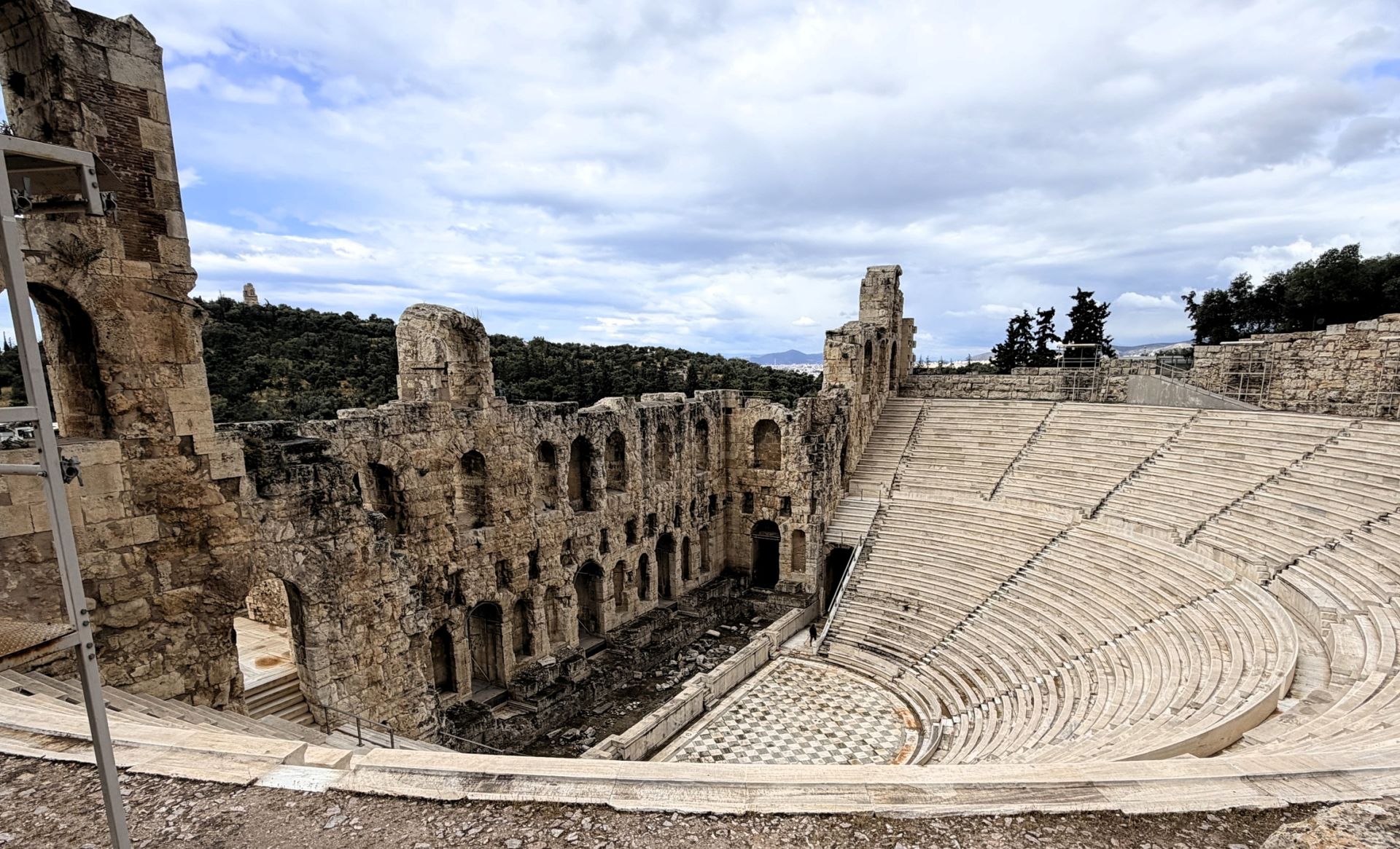 Visitors entered through a mosaic floored portico, which served as a transitional space between the exterior and the enclosed auditorium. The portico’s decorative flooring and colonnaded design signalled the luxury and ceremonial importance of the building. In front of the Cavea was a three storey stage façade (scaenae frons) this was constructed in stone and reached 28 metres in height. It served as both backdrop and acoustic reflector. The first storey contained large arched doorways (the valvae) for actor entrances, framed by engaged columns. Storey 2 consisted of alternating columns and rectangular niches for statues of emperors, benefactors, and deities and storey three incorporated smaller architectural members, likely with additional niches and decorative reliefs. 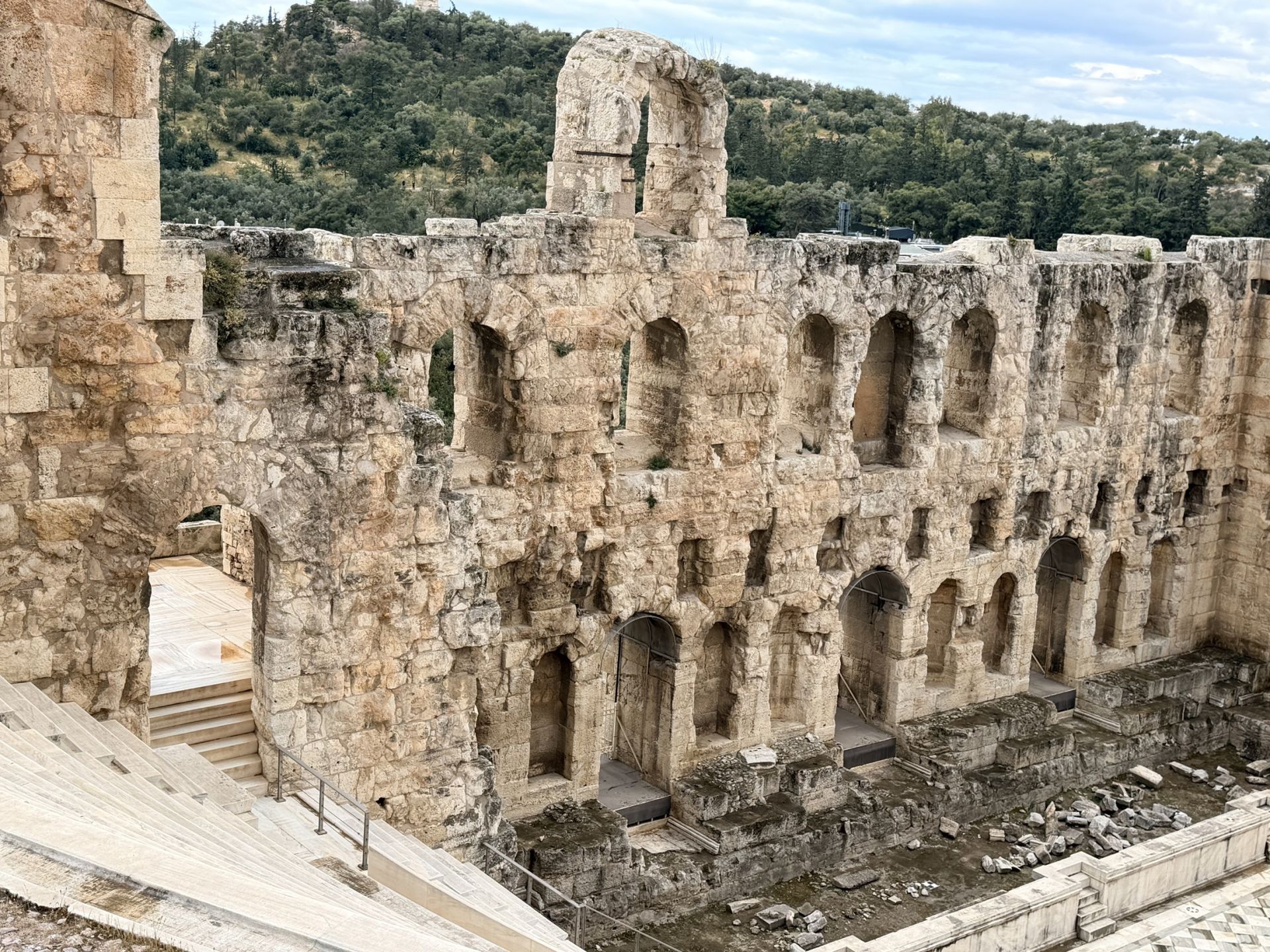 One of the Odeon’s most remarkable features was its wooden roof made of expensive cedar of Lebanon timber. Ancient writers praised this roof for its beauty and engineering sophistication. It fully enclosed the auditorium, making the Odeon function more like a Roman concert hall than an open Greek theatre. The roof was destroyed when the Herulian sacked Athens in 267 CE. In the 1950s, the Odeon underwent major restoration under architect Anastasios Orlandos, who rebuilt the seating and orchestra using Pentelic marble. This restoration made the building functional again and made it a major venue for international music performances. Today, the Odeon is not only a key architectural landmark on the Acropolis slopes, but it stands as a living monument linking ancient and modern Athens and provides a reminder of the cultural patronage of Herodes Atticus and the Roman presence in Athens. It is also a prestigious performance space with world class acoustics which provides high profile performances such as those by Maria Callas; Frank Sinatra; Nana Mouskouri; Luciano Pavarotti, Vangelis; and Sting. These ensure the building remains not just an archaeological site, but a vibrant part of Athens’ cultural identity and a central component of the annual Athens Festival. References and Additional Sources of Information https://landlifetravel.com/landmark/odeon-of-herodes-atticu/ https://en.wikipedia.org/wiki/Odeon_of_Herodes_Atticus https://www.ancient-history-sites.com/sites/odeon-of-herodes-atticus/
|
 |
|
 |
|||


All Photographs were taken by and are copyright of Ron Gatepain


| Site Map |