





 |
|
|||||||||||||||
 |
||||||||||||||||











 |
|||
 |
Belkıs Aspendos Theatre – History, Architecture & Significance 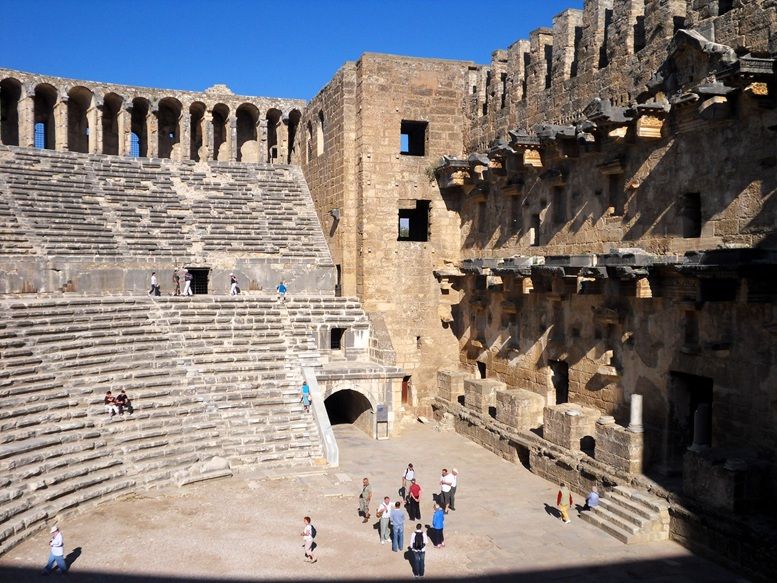
Aspendos Theatre, named after the ancient city which is where the theatre stands, is located in Belkıs, near Serik in Antalya Province, and is one of the best‑preserved Roman theatres. The reason it has survived so well is due to a number of factors such as the dry climate, which slowed erosion, and the attitude of the local population, which reused the structure ensuring its protection. Its construction incorporates Roman vaulting of exceptional quality, and it was built into a stable hillside. When the Seljuk Turks took the region in the 13th century, they recognised the theatre’s value and converted the stage building into a palace adding interior rooms; they also repaired the structural elements and preserved the Roman façade. During the Ottoman Period (14th–19th Century) the theatre gradually fell out of use but remained structurally intact. During that time, local villagers used parts of the theatre for gatherings. In the 1930s, Mustafa Kemal Atatürk, founder of modern Turkey, visited Aspendos and ordered that the theatre should be preserved and used. This resulted in a major restoration which stabilised the cavea enabling it to be reopened for performances: Today it is one of the best preserved Roman theatres in the world. The theatre was designed by Zenon, a local architect whose name can be seen in an inscription at the theatre, it was built during the reign of Marcus Aurelius (161–180 CE), one of the most stable and prosperous periods of the Roman Empire. An inscription inside the theatre states the names of: Zenon and of Curtius Crispinus & Curtius Auspicatus, the wealthy brothers who commissioned it. This inscription is the primary evidence that fixes the construction. It wasn’t built “just for shows”, however, it was a political statement, a civic monument, and a technological showcase. This enabled it to display Roman Power and Civic Identity and apart from entertainment it served as the City’s Main Public Gathering Space. The building, a perfect semi‑circle acts like an acoustic shell, focusing sound toward the audience with astonishing clarity. Consisting of a number of elements: The Cavea or Seating Bowl consists of two parts, the Lower cavea carved into the hillside - a Greek tradition - and the Upper cavea which was built on large vaults, something that was a Roman innovation. This contained the stepped stone courses to receive benches which were long stone seating blocks, set in regular rows, with a slight curvature to match the semi circle. This is supported by the Radial walls which are thick, load bearing walls that carry the vertical weight of the seating above. They run like spokes of a wheel, starting at the outer perimeter of the theatre and pointing inward toward the centre of the orchestra. Although the hillside supports the lower seating, the upper cavea rests on the Radial walls. Between each pair of radial walls, the builders constructed a barrel vault - a semi cylindrical stone arch that runs front to back to support the upper seating rows. These distribute weight sideways into the radial walls and also create internal passageways (vomitoria) for crowd movement. 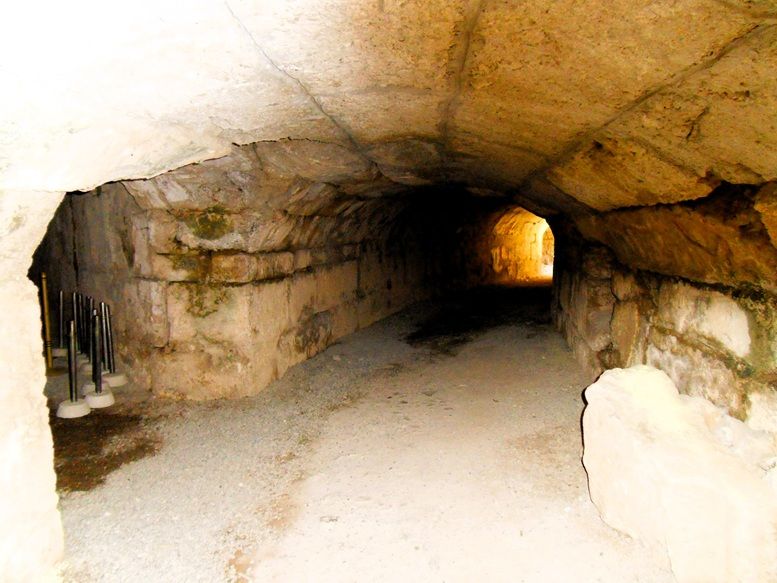 Ambulatories, the curved corridors running along the theatre’s perimeter, and Vomitoria, which are short tunnels cut through or between vaults, allow people to emerge into different seating levels. 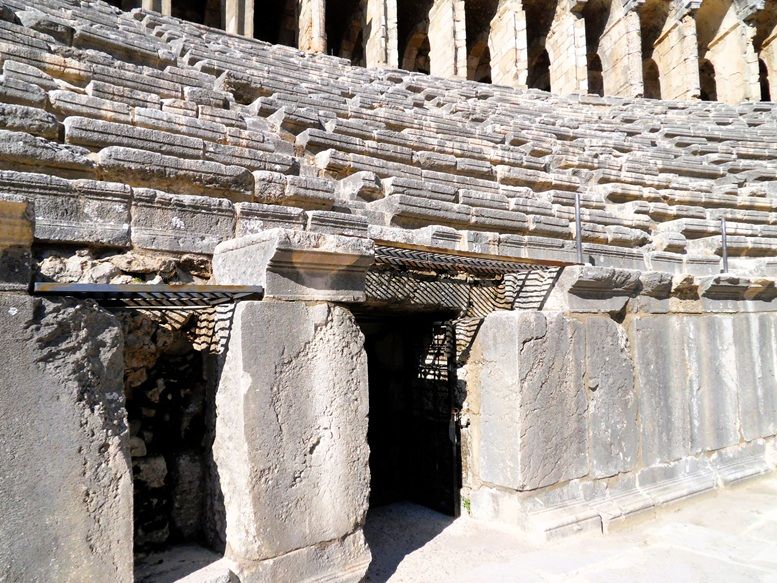 The upper and lower seating was divided by the Diazoma, a horizontal walkway; stair flights (kerkides) were built radially to segment the cavea into wedges. Low walls and safety edges were added at the top and along stairways. 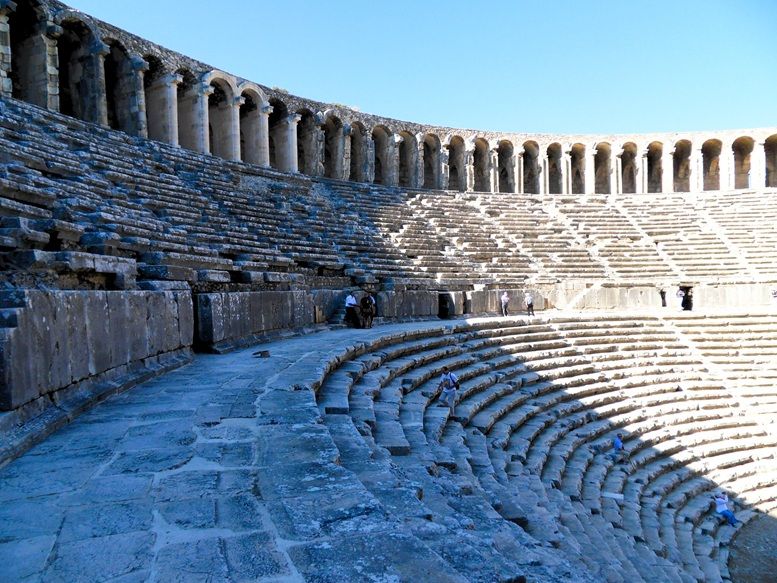 The Orchestra is a half‑circle, typical of Roman theatres which is used for ceremonial presentations, musicians, and civic announcements. Traces of the marble paving are still visible The Orchestra is the semicircular floor area at audience level, while the stage is the elevated platform behind it where the actual performance took place. 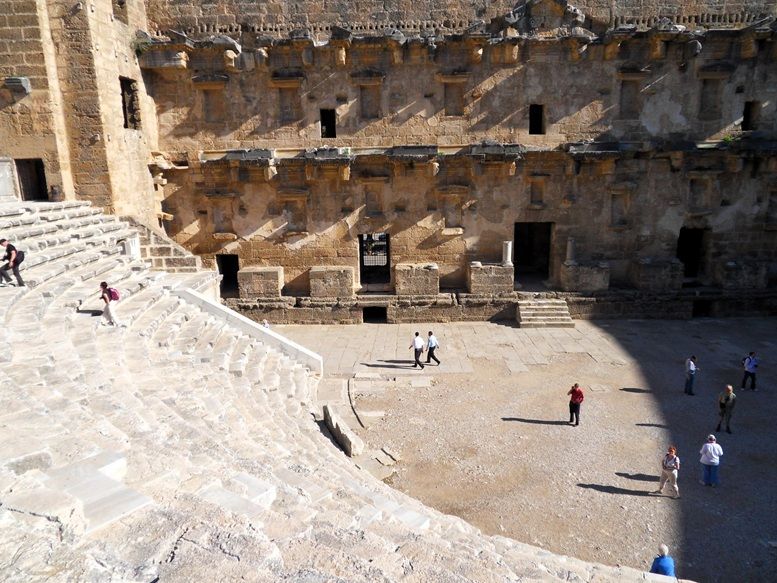 A large masonry wall was built behind the stage, with access doors and backstage rooms behind it. Most Roman theatres lost their stage walls (The Scaenae Frons), Aspendos’s is still fully intact and is Multi‑storey façade rises nearly 30 metres, giving a complete view of a Roman theatre. 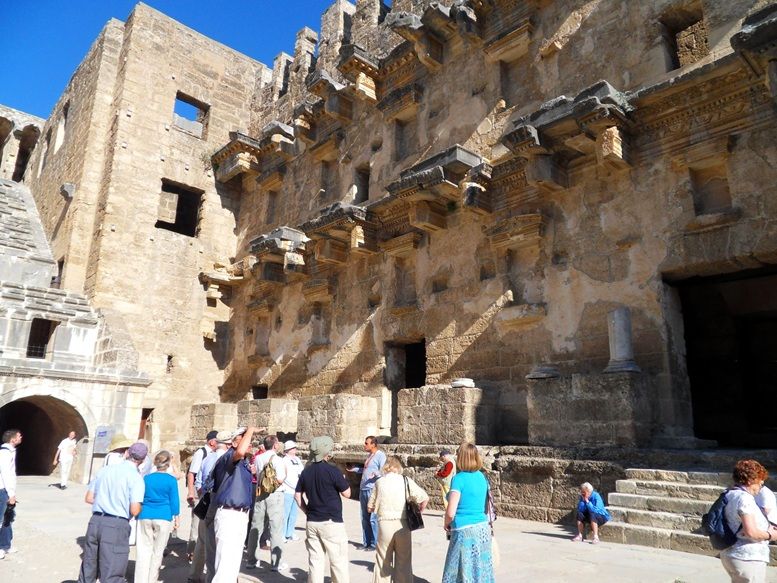 Originally with Corinthian columns, although only parts of these still remain. 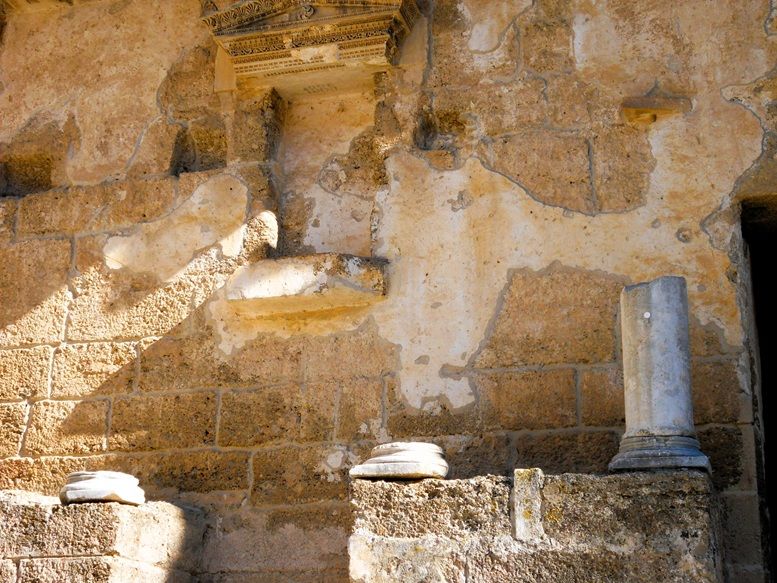 It also had Niches for statues, architraves, cornices and richly carved entablatures which can still be seen. This supported a wooden roof that amplified the sound. 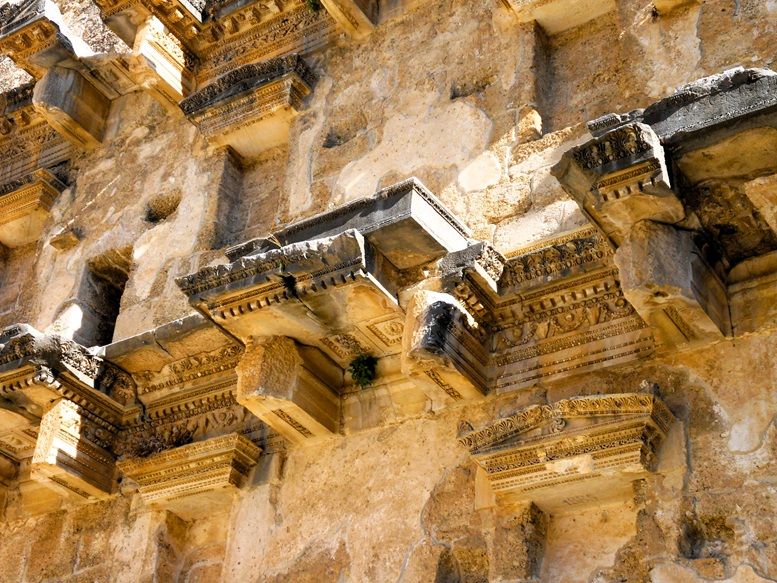 Interior surfaces, especially the stage wall, would be plastered and painted; decorative details were sharpened and polished. The building also had a drain to carry rainwater away and the orchestra and key circulation areas were paved with stone or marble slabs. Aspendos Theatre is one of the most complete examples of Roman architectural ingenuity, its fusion of carved bedrock, radial masonry walls, and interlocking vaults present an example of the Roman Empire’s structural and acoustic achievements. Its significance extends beyond engineering: across Byzantine, Seljuk, Ottoman, and modern interventions, the building has retained a continuous historical presence. Aspendos offers an unparalleled glimpse which enables us to understand both the technical ambitions of Roman theatre design and the evolving cultural landscapes that have sustained it for nearly two millennia.
|
 |
|
 |
|||


All Photographs were taken by and are copyright of Ron Gatepain


| Site Map |